
If you have a scooter at home, you have surely heard of the term variator. In this article, we will explain how your motorcycle’s variator works and how to get the most out of this component.
What is a variator?
The variator of a scooter is one of the most important parts of this type of motorcycle, since, as it does not have a manual gearbox, it is responsible for changing the gear ratios or developments of our scooter.
To understand it more simply, we should see the variator of our scooter as the chainrings of a bicycle’s gear system. If we use a large chainring, we will have to apply more force, but we will travel farther with fewer pedal strokes; with a small one, we will move with less effort, but we will have to pedal more.
We will find the variator of our motorcycle located right at the beginning of the scooter’s transmission, connected to the engine crankshaft to transmit all the power it generates to the wheels.
Parts of a variator
A scooter variator is made up of different parts, although depending on the type of variator, as we will explain below, these may change. The composition of a variator is as follows:
Bushing: It is a metal cylinder on which the variator rests and which secures it for proper operation.
Pulley: The part in contact with the scooter’s transmission belt.
Weights or rollers: Counterweights responsible for the operation and opening of the variator. The lower the weight, the later the opening and the greater the acceleration. Conversely, the higher the weight, the earlier the opening and the higher the top speed.
Ramp or bell: Internal part of the variator on which the weights or rollers slide, depending on the type of variator.
Grease only in certain models: Only conventional variators use grease to lubricate and reduce friction between the bushing and the variator.
In any type of variator, we will find that the pulley is in direct contact with the belt and that this is delimited by a half-pulley that guides it.
Types of variator
There are different manufacturers on the market that produce this type of component for scooters, not only as a replacement part in case the original one breaks down, but also to increase the performance of our motorcycle.
Both types of variators work thanks to the centrifugal force generated by the scooter’s crankshaft, but we can distinguish 2 types of variators according to their internal movement:
Conventional or roller variator
It is the most widely used type and the one fitted as standard by manufacturers, as well as by some performance manufacturers, where the ramps, guides and roller weights are modified to obtain different performance results.
In this type of variator, the rollers move longitudinally, rolling, to open or close the variator and deliver the engine’s power to the transmission system.
The rollers move along ramps located inside the variator. Depending on the inclination or slope of the ramps, the characteristics and result on our motorcycle will be different.
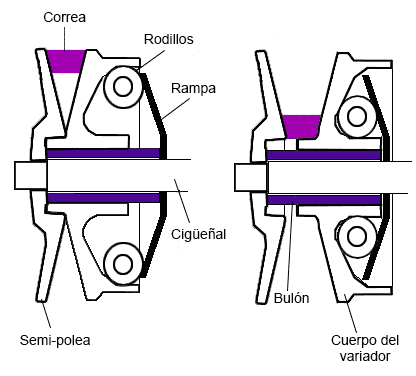
Transversal variator
It is the least known but the most efficient of the two, as it simplifies operation and improves the characteristics or performance that a conventional one can offer.
Unlike a conventional variator, in the transversal variator (also known as an axial variator) we do not find rollers but weights. The weights are counterweights made of Kevlar and a plastic compound that have a function similar to that of rollers.
In this case, instead of the rollers moving longitudinally, the weights move transversally, applying force to the variator bell and causing it to move in order to open or close the variator.
The bell in a transversal variator is a key element, as it replaces the function performed by the ramps. The correct operation of the variator depends on it having a properly calibrated bell.
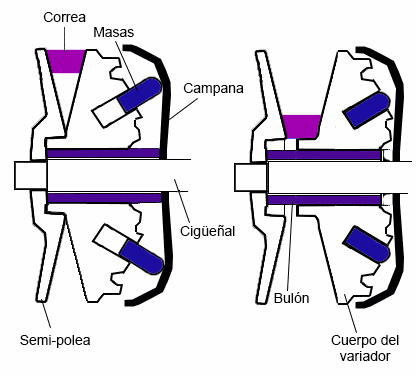
Advantages of a transversal variator
By installing a transversal variator on our scooter, we will not only improve the performance of our motorcycle, but we will also gain convenience and comfort in 4-stroke engines. With a transversal variator, we will compensate for the small irregularities of a 4-stroke combustion engine because we reduce internal friction within the transmission group.
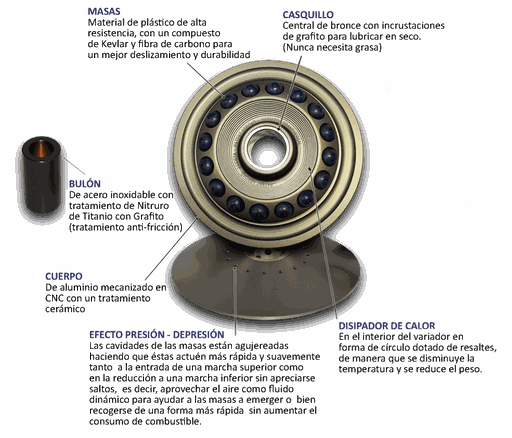 JCosta transversal variator and its parts
If we pay attention to the performance we can obtain with a transversal variator, we observe that we will gain speed both at low speed and at high speed. It will allow us to have more acceleration with the variator closed and a higher top speed with the variator open.
On many occasions, another result of fitting a transversal variator is that our engine runs more smoothly. As a consequence, the engine will suffer less and may last more kilometres than with the standard variator.
If you are looking to improve the performance of your motorcycle or simply maintain your scooter, visit our store and find your JCosta variator at the best price.