All motor lovers and enthusiasts agree that the sound of an internal combustion engine is a unique melody, characteristic of each vehicle. If the engine is the singer, our motorcycle’s exhaust pipe is the sound system that lets us perceive all the notes emanating from our engine.
In this article, we are going to teach you how to differentiate the types of motorcycle exhaust pipes for 4-stroke engines that exist, so you can choose the ideal one for yours and get the most out of it. Are you ready? Then put on your helmet, because we are starting!
Parts of a motorcycle exhaust pipe
Before getting into the subject, it is important to know the parts of an exhaust pipe in order to understand what role each one plays and whether we are interested in replacing our complete exhaust, or only certain components of it.
Silencer: This is the final part of the exhaust. Its function is to reduce the sound generated by the engine and expelled through the exhaust pipe. It also acts as a styling element and gives our motorcycle a sportier character.
DB Killer: A component located at the outlet of the exhaust collector that reduces the sound coming out of the silencer. It makes the sound waves return towards the inside of the silencer and reduces the decibels that finally reach us. Riding without this element is punishable within the European Union.
Collector: Connecting pipe between the engine gas outlet and the silencer. Depending on the material, collector length, diameter and shape, our motorcycle will acquire certain characteristics or others.
Lambda sensor: It is a sensor that controls the oxygen concentration in the exhaust gases so that the engine adjusts the petrol and air mixture it sends.
Catalytic converter: Element that filters and combines the engine gases to reduce the polluting gases emitted to the outside.
Types of exhaust pipes according to their installation
We can differentiate motorcycle exhaust pipes by various criteria, one of them being how they are installed or mounted on our motorcycle. We can divide them into 2 types of exhaust pipes: slip-on exhausts and complete exhausts (full exhaust system).
Slip-On Exhausts
Slip-on exhausts are only made up of a final silencer, adapters and a series of hooks and springs for fastening.
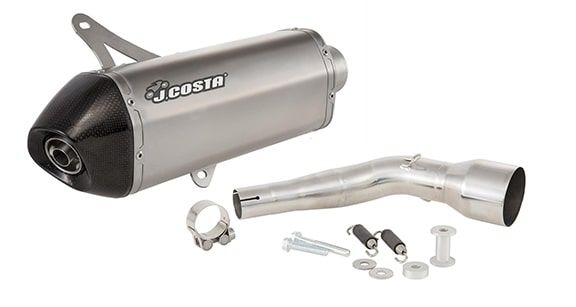
This type of exhaust is usually installed on the standard collector of our motorcycle, fitting by means of a stainless steel or titanium elbow. As a general rule, we will have to cut our standard exhaust pipe to install the silencer and weld some hooks onto the collector so that, by means of springs, the exhaust is properly adjusted if the elbow does not already have them installed. It is quite common for them to also include a metal clamp to further reinforce the joint and ensure it is firmly secured.
These motorcycle exhaust pipes have the advantage of being more economical than a complete exhaust system, since we avoid installing new collectors and use the ones we already have on our motorcycle. In addition, we will gain sound and reduce weight by changing the standard silencer, which is usually more restrictive and heavier.
Complete exhaust line
Unlike Slip-On exhausts, complete exhaust lines include all the necessary elements to replace your motorcycle’s standard exhaust without modifying the original components.
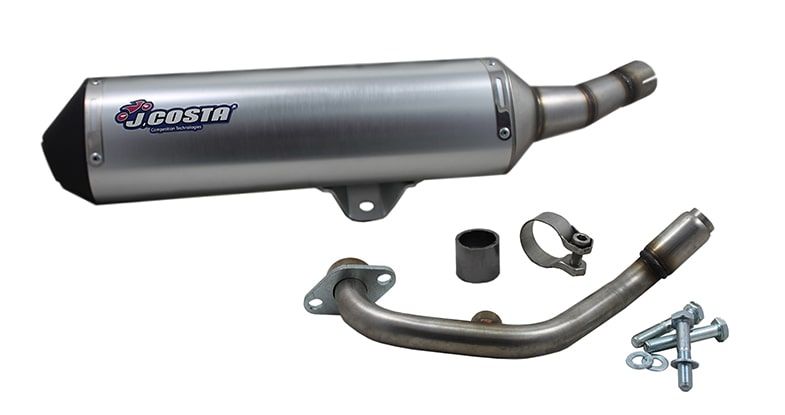
This type of exhaust provides us with greater performance, as it works with a custom-developed collector and, generally, with lighter materials than standard collectors. In addition, it offers us the same advantages as a slip-on exhaust: the weight of the entire exhaust is reduced and a better sound is achieved.
The type of connection is usually cleaner than that of a Slip-On exhaust, since the collector has been designed to work together with the silencer. The fit is better and there is less chance of gas leaks.
On the other hand, complete exhaust lines are usually more expensive than if we only buy a silencer, although there are cheap complete motorcycle exhausts that allow us to obtain performance without sacrificing price.
Types of exhaust according to approval
When we talk about approvals, we refer to the regulations established by the European Union, which are the most restrictive compared with the rest of the countries in the world. We recommend that you check the regulations established in your place of residence before choosing one exhaust system or another.
According to the European Union, exhaust systems must meet a series of sound and emissions standards in order to be considered approved. Manufacturers must pass a series of inspections when launching a new exhaust model on the market in order to obtain the approval certificate for that product.
Riding with a non-approved exhaust pipe is not permitted and is punishable with a financial penalty and, in some cases, even removal of the vehicle from public roads.
Within approved exhausts, we can distinguish 2 types of exhausts: catalysed exhaust pipes or non-catalysed exhaust pipes.
Approved non-catalysed exhaust pipes
Approved non-catalysed exhaust pipes are the most common on the market, as they comply with the sound regulations and specifications set by the Directorate-General for Traffic (DGT). This means that we can ride with our exhaust without risk of receiving a fine.
The surprise and main difference is that, by not having a catalytic converter, the exhaust pipe does not retain the amount of gases that in many cases is required for our motorcycle’s approval. This means that it is likely that we will not pass technical inspections (ITV) due to gas emissions.
So remember, do not get rid of your original exhaust pipe until you are sure that your new exhaust passes the gas tests. Many users resort to their old exhaust pipe to pass technical inspections.
Approved exhaust pipes with catalytic converter
The catalytic converter is an element that acts as a filter inside our exhaust pipe, allowing only a percentage of the gases generated in our engine to exit to the outside. For this to happen, the catalytic converter combines the gases emitted by the engine to obtain a chemical compound that is not harmful, or at least not as harmful as if the gases were expelled without being catalysed.
Depending on the motorcycle’s displacement, the catalytic converter will be larger or smaller, and may even be almost unnoticeable because it is integrated directly into the collector or silencer.
An approved exhaust pipe with a catalytic converter is the most convenient and safest option to avoid worrying about gas emissions and to avoid having to remove the exhaust from time to time, as we mentioned earlier.
Not everything is good news, since by installing a catalysed exhaust we reduce to some extent the power we gain by replacing our original pipe with another one, and we will practically only obtain a better sound.
Catalysed exhausts are the hardest to find, as 90% of users prefer to install an approved non-catalysed exhaust pipe and save the cost of a catalysed exhaust.
Conclusion
As in most cases, there is no solution that is better than the other; rather, one type of exhaust pipe will be better for one type of user and other exhausts for others. What we do recommend is that if you want to change your exhaust pipe, install an approved exhaust to avoid problems with the law.
If you want to find a high-quality exhaust approved with European certification, do not forget to visit our large selection of exhaust pipes for your motorcycle.