As you probably already know, there are different types of engines that can be fitted to a scooter. If we classify engines by their strokes and the way they carry out combustion, we can categorise them into 4-stroke engines and 2-stroke engines. If you are interested in learning the particularities of each one, stay with us and we will explain them!
What is a 4-stroke engine?
The 4-stroke engine gets its name from the number of phases that make up a complete engine operating cycle. The mechanics of a 4-stroke engine can be found both in engines that run on petrol and in engines that run on diesel or gas oil, but this does not mean that we can mix fuels, as they work in completely different ways.
In this article, we will focus on petrol 4-stroke engines, as they are the ones used in today’s motorcycles and scooters.
Characteristics of a 4-stroke engine
A 4-stroke engine is characterised because its operation can be divided into 4 stages:
Intake: The piston moves down and the air-fuel mixture enters the combustion chamber through the intake duct.
Compression: The piston moves up through the cylinder and compresses the mixture. In this phase, all valves remain closed.
Explosion: At this moment, the spark plug comes into play, producing a spark that causes the air and petrol mixture to explode in a controlled way inside the combustion chamber.
Exhaust: As a result of the explosion, the piston moves downward and the exhaust valve opens so that the gases from the explosion can leave the engine.
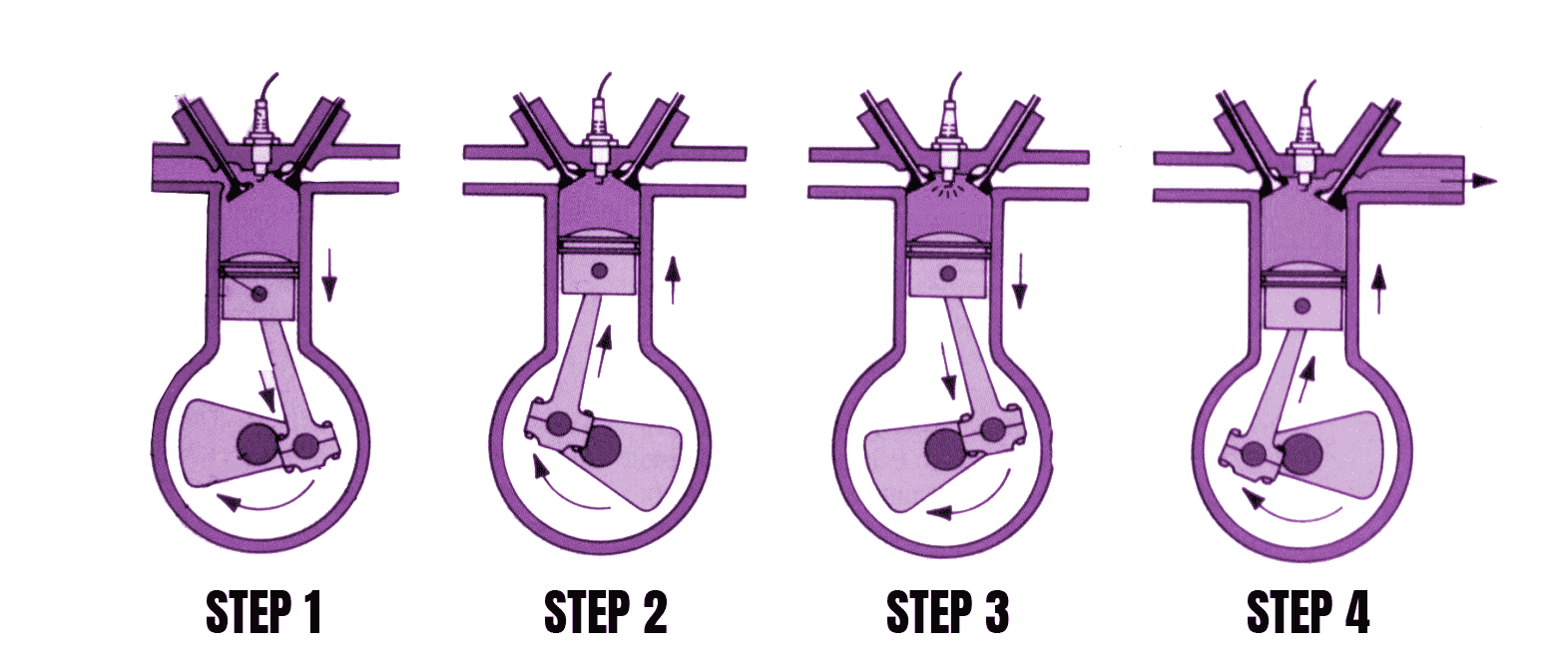
Every 2 turns of the crankshaft, or every 2 revolutions, the 4 stages of the 4-stroke engine operation are completed.
Advantages of a 4-stroke engine
The main advantages and reasons why 4-stroke engines have become the most widely used in the scooter and motorcycle sector are the following:
Controlled and efficient fuel consumption.
Easy refuelling because it does not need a mixture of petrol and oil.
Less maintenance of its components.
Lower CO2 emissions.
Fewer vibrations.
Disadvantages of a 4-stroke engine
Although these are not really disadvantages, but rather characteristics of this type of engine when compared with 2-stroke engines, we can identify the following drawbacks:
The weight is greater than that of a 2T engine.
Repairs are usually more expensive.
Lower power.
How to improve the performance of a 4-stroke engine?
As we have already mentioned previously in the article on how to increase the power of a 125cc motorcycle, there are different modifications that a 4T engine can undergo.
The least intrusive ones involve removing restrictions derived from the combustion process, such as replacing the standard exhaust pipe with another one with fewer restrictions so that the engine does not have to make so much effort in the exhaust stage. In this way, we will obtain greater energy efficiency and improve its performance.
All the modifications we make to an engine will involve increasing the displacement, by changing the cylinder head for a taller one or fitting a larger cylinder, for example, reducing weight, or adjusting the fuel mixture, its quantity and detonation.
What is a 2-stroke engine?
The 2-stroke engine, just like the 4-stroke engine, gets its name from the number of phases that make up a complete engine operating cycle. The mechanics of a 2-stroke engine can only be found in petrol engines, specifically in vehicles that need high acceleration, such as a motocross motorcycle.
Characteristics of a 2-stroke engine
Unlike a 4T engine, in 2T engines it is necessary for the fuel to be enriched with oil to ensure proper operation
A 2-stroke engine is characterised because its operation can be divided into 2 stages:
Intake-Compression: The piston moves downward, allowing the mixture of petrol, oil and air to enter the combustion chamber for compression.
Explosion-Exhaust: The petrol and oil mixture enters and is stored in the pre-compression chamber, while the fuel explosion takes place in the lower part of the cylinder.
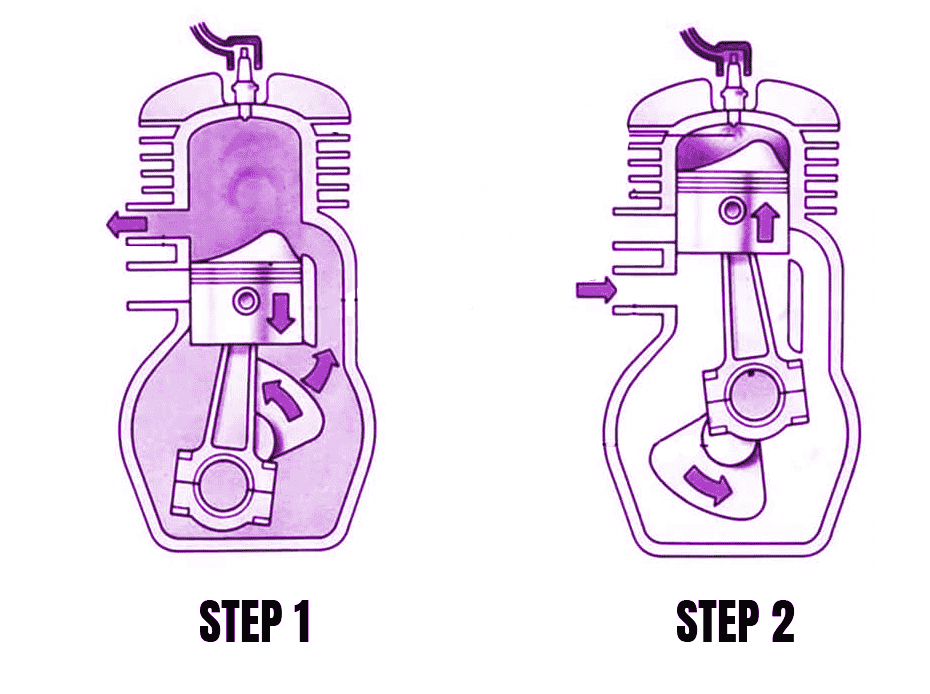
Every turn of the crankshaft, or every engine revolution, the 2 stages of the 2-stroke engine operation are completed.
Advantages of a 2-stroke engine
2-stroke engines continue to be used by manufacturers because:
As they do not have valves, they are simpler and cheaper than a 4-stroke engine.
They develop more power than a 4T engine of the same displacement.
The cost of repairs is lower.
They weigh less than a 4T engine.
They can operate in any position because they do not have lubricants in the crankcase.
Disadvantages of a 2-stroke engine
Just as with 4-stroke engines, with this type of engine we also find a series of disadvantages that are characteristic of 2T engines:
They consume more fuel and not all the fuel consumed is used efficiently.
They generate more CO2 emissions.
As they operate at a higher rev range, the engine and its components wear out more.
Conclusion
As a general conclusion, we can say that one engine does not replace the other; rather, they have different uses. Depending on the needs and uses, one or the other will be better.
It is also true that, due to emissions regulations, in recent years brands have decided to use 4-stroke engines for their scooters, as they are understood to be intended for urban use. In contrast, 2-stroke engines have remained for more recreational use, such as off-road motorcycles or racing scooters.
If you want to get the maximum performance from your scooter’s 4-stroke or 2-stroke engine, do not hesitate to check out our range of components for your motorcycle. Discover the variator that changed the world of scooters!